DISCOVERING CAO BANG : TOP 7 MUST SEE
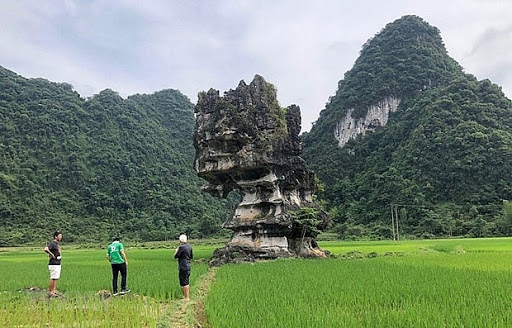
Tucked away in a remote area of Northern Vietnam, Cao Bang Province is bursting with beautiful geo-cultural sites. With five major river systems and 47 lakes, water plays a vital role in shaping the landscape and local life. Much of Cao Bang is protected as UNESCO Global Geopark. The province’s extraordinary diversity makes it a spectacular place to explore, especially for adventure travellers. Here are seven stops in Cao Bang you must not miss.1.Ban Gióc Water fall
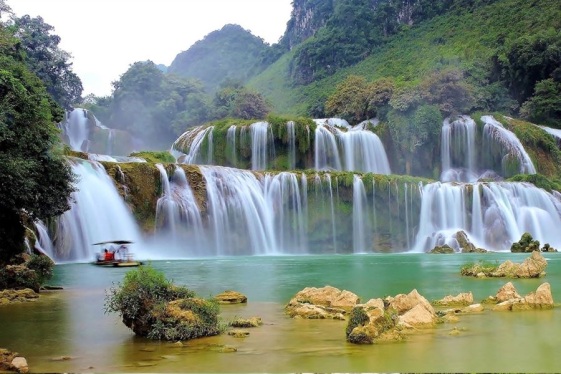
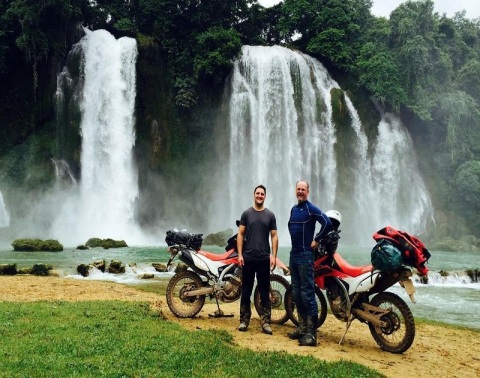
Ban Gioc Waterfall is located around 365km from Hanoi in Dam Thuy Commune, Trung Khanh District, which originates from the peaceful Quay Son Rivers. It is the fourth largest waterfall in the world and is also the most beautiful and majestic waterfall in Vietnam. With a width of 300m and a height of 53m, the waterfall is split into three layers. It’s divided into three falls by trees and rocks. The feature hue of the waterfall in autumn is turquoise. At the foot of the waterfall is a flat and wide river with forests and green grass. Travelers can sit on floating rafts on Quay Son River and see local people fishing. Recently, Ban Gioc Waterfall has been listed by Wonders List website in the top ten greatest waterfalls in the world..
Note: The best time to visit is during the dry season from October to April. At the end of the dry season, a daily release of water from the dam-controlled Quây Sơn River takes place between 10:30am and 1:00pm, bringing the falls up to their full flow.
2. Phat Tich Truc Lam Ban Gioc Pagoda
The pagoda is located on Phia Nhu Mountain, Dam Thuy commune, around 500m from Ban Gioc Waterfall. It is the first pagoda was built in the border region in the north in 2013. You can watch the entire Ban Gioc Waterfall from the pagoda. The pagoda is particularly rich in traditional Vietnamese religious architecture patterns, which sits on a land plot of about three hectares in Trung Khanh District. The pagoda includes a three-door gate, drum tower, bell tower, steles, temples of national heroes (Nung Tri Cao), guest houses, Hung Kings, and a beautiful landscape.
3. Nguom Ngao cave
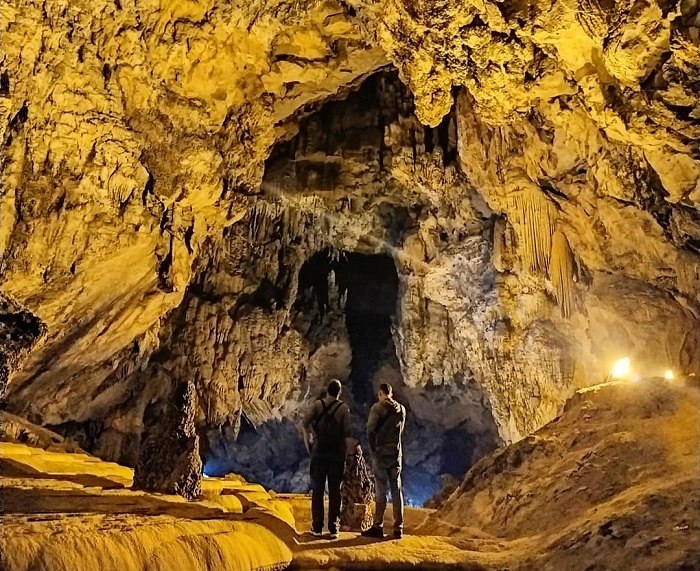
Nguom Ngao Cave is located in Gun Hamlet, Dam Thuy Village, Trung Khanh District, about 90 km from the city of Cao Bang. It was explored by local people in 1921. The cave is regarded as a most beautiful cave in Vietnam due to its size and uniqueness. Nguom Ngao in Tay’s language means cave between rock valleys or tiger cave. Nguom Ngao cave includes three main gates with 2,144 meters in length. The first gate is Nguom Lom which is cool all year round and hidden under rocks at the foot of the mountain. The second one is Nguom Ngao which is several hundred steps from the foot of the mountain. The third one is Ban Thuon gate which is behind the mountain, next to the Thuon village of the Tay people. Nature has endowed Thang Hen cave with stone formations looking like human beings, plants, trees, and mythical animals. Furthermore, the cave is very large, and one branch reaches nearly all the way to the waterfalls. The system of stalagmites and stalactites has created an extremely interesting and magnificent scene.
4. The Thang Hen lakes
Thang Hen is situated in Quoc Toan Commune, Tra Linh District, around 25km far from Cao Bang town with 1000m in width and 3000m in length. The name of the lake in Tay’s language means bee tail because the lake looks like the bee tail from above. In front of the lake, there is a large cave and water flows from it all day and night. Thang Hen Lake has beautiful scenery with green trees bending around the valley of boulders, shining down to the blue water, and stretching out over the cliffs. The best time to visit the lake is in the rainy season from September to October. The lake is much smaller in the dry season. Thang Hen Lake was recognized by the Ministry of Culture and Information in 2002 as an ecological tourism area of Cao Bang Province.
5. Ethnic minority groups
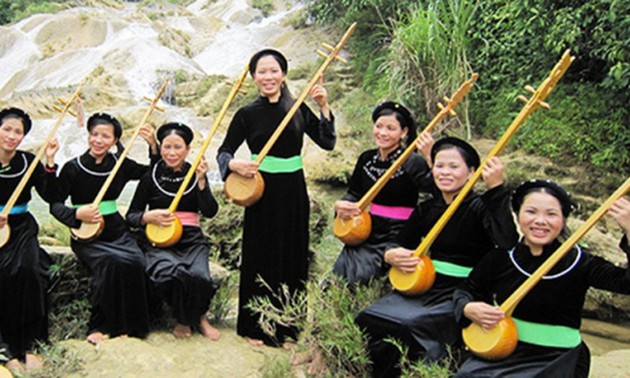
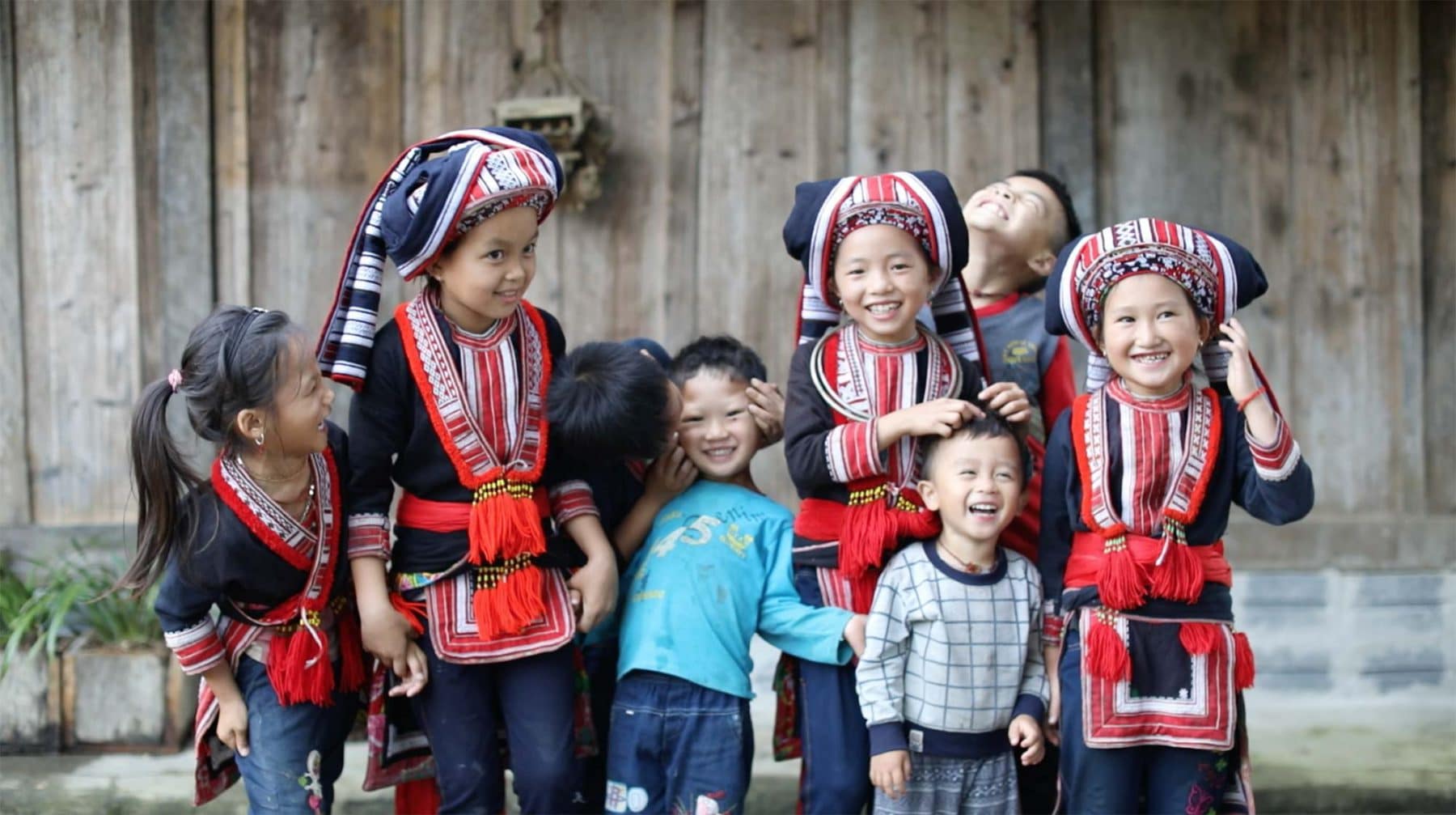
Cao Bằng Province has over nine ethnic groups, which have lived in these valleys for centuries. The Tày, Nùng, Dao, and H’mong are some of the most well-known, and each minority has its own special crafts and way of living. To experience ethnic culture, visit a minority craft village with one of the local guides, or book an ethnic homestay during your trip.
6. Pác Bó Historical Complex
Pac Bo belongs to Truong Ha commune, Ha Quang district, Cao Bang province and is a particular relic of history in Vietnam. Pac Bo is a place where President Ho Chi Minh worked and led the revolution of Northern Vietnam. There are a lot of famous relics in Pac Bo historical site marking a historical period of Vietnam. Tourists can have an opportunity to know about a heroic stage in the history of Vietnam through many vestiges: Pac Bo cave, the memorial house of Uncle Ho, Cave of Nguom Vai (hang Ngườm Vài), Lenin stream, Lung Lan cave (hang Lũng Lạn), Stone table where President Ho Chi Minh worked, etc.
7. Phia Oac (Đỉnh Phia Oắc)
Phia Oac belongs to Nguyen Binh District, Cao Bang Province. Phia Oac spreads over four communes namely Quang Thanh, Thanh Cong, Tinh Tuc, and Phan Thanh. Phia Oac is the root of Cao Bang with a peak of 1.931m above sea level. Phia Oac attracts travelers with its huge salmon aquaculture, beautiful landscapes of diverse forests, national parks with more than 300,000 hectares, and nature reserves.
ALL THINGS YOU SHOULD KNOW BEFORE TRAVELLING TO CAO BANG
If you are a discoverer, you definitely cannot ignore the “Green Jewel” in the Northeast of Vietnam. It’s Cao Bang. Please prepare immediately for the journey to the mountains of Cao Bang travel experience that Origin Vietnam will share now.Situated in the Northeastern of Vietnam. Sharing border with, Bac Kan, Lang Son & China. It’s about 218 km from Hanoi City. Cao Bang’s topography is among the most complex within the country that’s transportation is restricted. So the local people here mostly using motorbikes move from one place to another to save energy.
1.How Cao Bang is unique?
While talking to Cao Bang province all people will think it’s famous with Ban Gioc Waterfall . But not only with Ban Gioc but Cao Bang province also famous for it’s history. Because the Uncle Ho. The first president of Vietnam returned on December 1941 through China. Being located directly on the boundary with China supposed that Cao Bang was a zone of contention between the two countries. It also played a significant part in the movement, acting as a basis for the North Vietnamese revolutionaries and earning the nickname Cradle of the Revolutionary Movement.
2. What to do in Cao Bang?
For a time. Ho Chi Minh took refuge in Pac Bo cave. The region is starting to garner more attention from adventurous travelers seeking to get away from the overcrowded and above visited tourist locations and wanting to experience the rugged beauty of the frontier region. Due to its northern location, Cao Bang is cooler than the rest of Vietnam with an average temperature of 25-28 degrees in summer and 16-17 degrees in winter. A number of the peaks sometimes see snow in especially cold bouts. The cooler climes, rich forests and clean air makes Cao Bang a nature escape that leaves visitors feeling refreshed and filled with appreciation for the beauty of nature.
There are multiple places which contain war remnants about the Vietnam Revolution throughout the French colonial era namely the Lenin Stream, Coc Bo Cave, Pac Bo, and Khuoi Nam Stream at which Uncle Ho Chi Minh worked and lived before the beginning of August 1945. Like some other mountainous areas in Vietnam, Cao Bang has many cultural minorities like H’Mong, Tay, Dao, Nung, San Chay and 11 others cultural groups. The varied groups offer an exceptional culture in the province. Lots of traditional festivals from the cultural groups are celebrated. Join in on the festivals like the Long Tong Festival and Moi Me Trang.
3. How to travel to Cao Bang?
From Ho Chi Minh City, Da Nang or Can Tho to Cao Bang, you will have to fly to Hanoi and then continue to Cao Bang.
- By Bus
- By motorbike
You can follow one of the three suggestions below:
- Traveling from Hanoi along National Highway 3 through Thai Nguyen, Bac Kan. On this road you can also drop by Thai Nguyen or Bac Kan, especially there is the well-known chilling place Ba Be Lake.
- Traveling from Hanoi along Highway 4 to Lang Son, combine to visit Mau Son and follow the direction of Dong Khe and That Khe to Cao Bang.
- If you go to Ha Giang by motorcycle from Hanoi, when coming back you can follow the direction of Dong Van to Meo Vac, go through Bao Lam, Bao Lac, Tinh Tuc (Nguyen Binh) and turn toward Bac Kan, crossing the Ba Be Lake resort before returning to Hanoi
Long Tong Festival is one of the biggest Tay celebrations of the year. The festival takes place throughout many Tay villages in the north of Vietnam on the 4th day of the lunar year. The spring festival is a chance for the villagers to worship the god of agriculture and pray for prosperous crops in the upcoming year. People prepare offerings of food for the gods and then celebrate with a feast and lively traditional games.
Another Tay festival, held in the Dong Khe region of Cao Bang is Moi Me Trang which means Mother Moon Festival. This is another spring festival which brings the local villagers together to celebrate and pray for prosperity. In particular, this festival is a chance to ask the moon for luck. The celebrations start with a beautiful ceremony of traditional singing and flower offerings which are followed by cultural activities and games.
5. Where To Stay In Cao Bang Province
Most of hotels and guest houses, home stay are situated in the center of Cao Bang city. However, the room rate isn’t expensive. It is advisable to book the room in the guesthouses and hotels at here early in advance to stay away from the case its prices are increased, or it is fully booked in the high season.
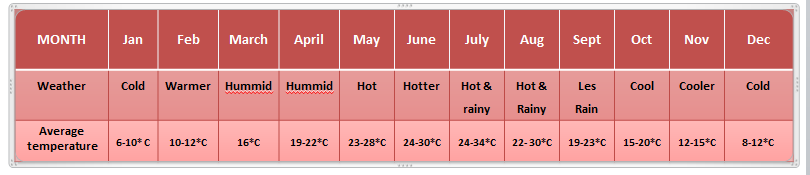
WEATHER – WHAT IS THE BEST OF YEAR TO GO TO CAO BANG?
Cao Bang is divided into two distinct seasonsRAIN SEASON
Rainy season which lasts from April to September
DRY SEASON
Dry season is from October to March. If you intend to travel to Ban Gioc waterfall,
BEST TIME TO TRAVEL
Should go around August to September, this waterfall will be very breathtakingly beautiful.
If you like to go to Cao Bang to see flowers, you can go to the end of the year around November, this is the Trichet flowers season (equivalent to Trichet flowers in Ha Giang)
If you like snow, you should go in winter months (last months of year to early next year), Pia Oac Forest’s temperature lowers in this time, so this phenomenon of snowing is likely. Combined with the journey schedule from Cao Bang to Lang Son (along the That Khe road), you can drop by Mau Son tourism, where almost every winter has ice or snow.
Weather in Sapa months
Unrivaled Food That You Can Only Find in Cao Bang
Arrival to Cao Bang, you will have an opportunity to try the traditional and local food in this mountain area. These traditional foods are very fresh, delicious and good for your health.
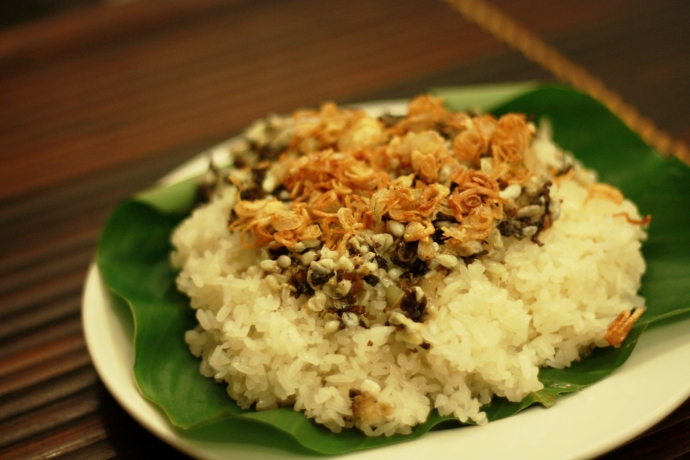
The food in Cao Bang is mostly typical of that in the North with some specialities of its own. Xoi tram Cao Bang is a regional take on the classic Vietnamese dish sticky rice which is mixed with fruit from the Carnarium tree to give it a rich purple colour.
Cao Bang also has some unusual dishes which feature insects on the ingredients list. Peng Ray, which translates to ant egg cake, is a seasonal delicacy for the Tay community in Cao Bang. Each year they gather the ant eggs from the nearby forests from April to May. The eggs are encased in a glutinous rice cake and wrapped in fig leaves. The dish is popular for its high nutritional value.
1.Cao Bang Sour Noodle Soup (Phở Chua Cao Bằng):
This dish is the specialty of Cao Bang Province. The noodle is ductile combining with the duck, bacon fat, and other herbs and seasonings.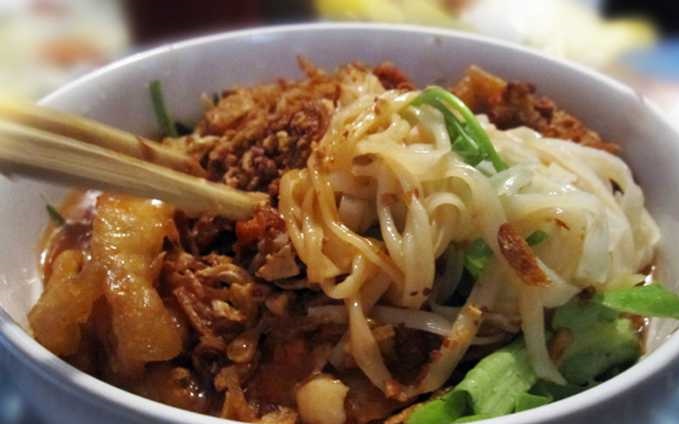
2. Trung Khanh Chestnut:
Trung Khanh is a well-known place where you will be enjoyed the most delicious fruit. Chestnut is famous in Trung Khanh which is plump and brown. This food can be boiled, cooked or steamed, which the best method to maintain the natural scent.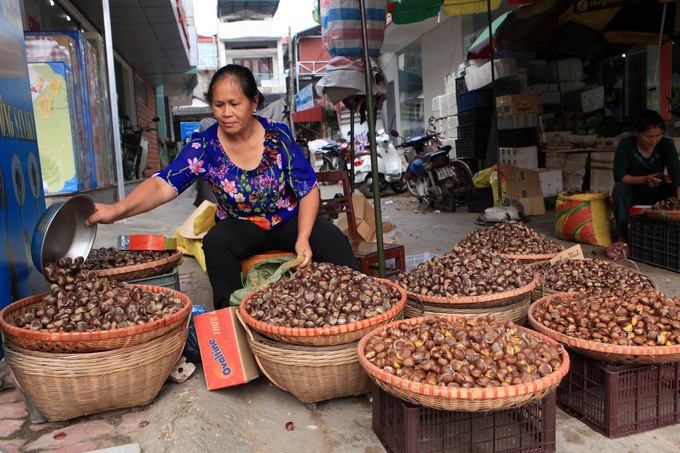
3. Peng Ray (Bánh Trứng Kiến):
In the language of the Tay people, Peng Ray means egg cake. In April or May, the Tay people often go to the jungle, gather ant’s eggs, bring back and then prepare a tasty cake with them. The ingredients of this cake include flour, fig leaves, and ant’s eggs. It impresses tourists by the fat of eggs, the fresh taste of fig leaves, and the flavor of onions.