5 DESTINATIONS YOU MUST CHECK IN TONLE SAP
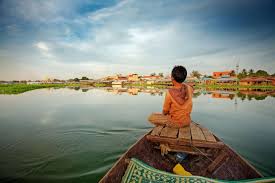
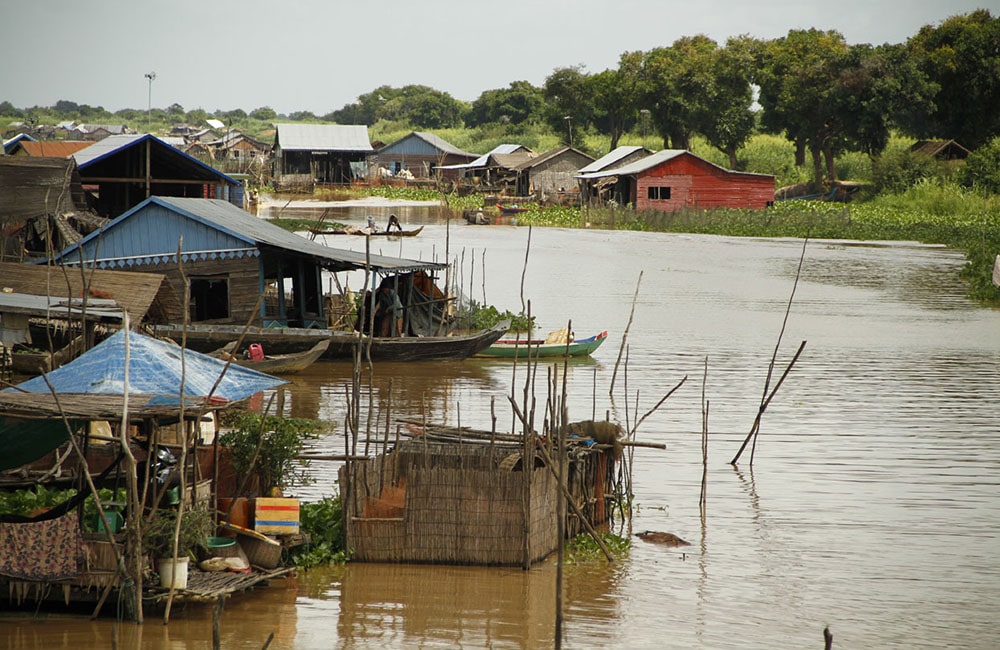
The Tonle Sap, also called “Great Lake”, is the biggest freshwater lake in Southeast Asia and covers an area of 2600 km² in the dry season to completely dominate the map of Cambodia.It is located about 17 km from Siem Reap and a great attraction on the Cambodia travel packages for tourists interested in seeing communities of floating villages that vary from the houses raised up on stilts (up to 10 meters) and boat houses.
The lake with his murky brown water is home to a variety of fish, mangrove trees, and has crocodile farms in the local area.
1.TONLE SAP FLOATING VILLAGE
Apart from Cambodians, Tonle Sap is also home to a lot of Vietnamese, who migrated to Cambodia in the 20th century. The reason why most of the villages depend on the lake is for the natural resources it provides, in terms of fishing and wetlands. Annually, fishermen can catch 300,000 tons of fish, which accounts for 75% of Cambodia’s fresh water fishing. In addition to fish, there are also birds, shrimps, reptiles and crocodile farms. In 1997, Tonle Sap lake was designated as a UNESCO biosphere.
The floating villages at Tonle Sap Lake seem to be of interest for tourists visiting Siem Reap. There are actually several floating villages located on and around the lake, each of them has its distinctive characteristics. Visiting these places enables you to see a new and different way of life. The four main floating villages are listed below.

2.CHONG KHNEAS
About 16 km southeast of Siem Reap, Chong Kneas is the closest village to access, which makes it a easy day trip for tourists. This is the most famous fishermen village of the Vietnamese minority. They live in floating houses, which are regularly moved around according to water levels, thus Chong Kneas is really more like a “floating village”. Other buildings like church, elementary school, restaurant, police station, shop, basket ball court,… are even on boats.
It is the one most visited by tourists. In the wet season, it really is a floating village, with houses, shops, schools, etc. all bobbing on the water.
Unlike many popular floating markets in Thailand, Chong Kneas is not entirely souvenir shops and food vendors. Most of the villagers are still fishermen, so you can observe their activities. Everything, even a small errand is done on the water. They wash, bath, swim and fish for dinner. Of course tourist spots are here, too. Usually tourist boats stop at a crocodile and catfish farm. It offers the opportunity to climb up to the rooftop and enjoy the view over the floating village. Although it may not be the most picturesque and somewhat more touristy, Chong Kneas is still interesting and worth seeing.

3.KAMPONG PHLUK
Located about 16 km of Siem Reap, Kampong Phluk consists of three villages of stilted houses built within the floodplain. There are 2 ways to reach the area: by boat from the Chong Khneas dock or by road in the dry season. Different from Chong Khneas, the main inhabitants of the village are Khmer. And only a few of tourists makes the journey to Kampong Phluk, which has helped it retain much of authenticity. You’ll see what traditional fishermen’s life is like over water – they are busy doing laundry, cooking or fishing on the wooden boats.
In addition, you can also take a small paddle boat into the mangroves to have a close look at this submerged forest. To end a day, you shouldn’t miss the stunning sunset view in the middle of Tonle Sap lake. The color is so intense when the sky changes from bright blue to luminescent orange.
4.KAMPONG KHLEANG
The village’s population is 10 times that of Kampong Phluk, making it the largest community. There are both floating houses and fixed ones raised on 10m wooden stilts. Many of them are open, so you can see directly inside into the living rooms, which all have their unique family designs. For those who have never seen such things before, it is a truly mind-blowing experience.
5.MECHREY
A quiet tourist spot of Tonle Sap Lake, Mechrey is a floating village about 15km north of Chong Khneas, and also the entry point to the Prek Toal Bird Sanctuary. The village’s economy is based primarily in fishing, and quite a few farm crocodiles as well. In addition, you can witness floating pig farms, school, gardens,… There is also a fair bit of wild bird life in the area.
It’s often said that the journey is prettier than the destination when it comes to Mechrey. It’s because the road to the village offer a great photographic view. The best time to visit is in late afternoon, when the children come back from school. Floating around, they will smile to you and wave time to time. It’s also when the village is at its best in the sunset light.
Bird-watching at the Prek Toal Bird Sanctuary
As well as the villages, Prek Toal is a must-see location for a kind of nature experience. Located on the Tonle Sap lake, this stunning bird sanctuary is one of the most important breeding grounds for endangered water birds in Southeast Asia. During the peak season (December to April), visitors will find the concentration of thousands of local and migratory birds like Black-headed Ibis, Spot-billed Pelican, Greater and Lesser Adjuncts, Painted Stork, Grey-headed Fish Eagle and many others. What will make you impressed is these birds all have a huge size and build enormous nests.
Exploring the Prek Toal Bird Sanctuary makes it one of the most worthwhile things to do besides visiting floating villages.
ALL THINGS YOU SHOULD KNOW BEFORE TRAVELLING TO TONLE SAP
GETTING TO KNOW TONLE SAP LAKE
Tonlé Sap is one of the most fish abundant lakes in the world, and supports 360 floating villages and thousands of waterbirds. It’s easily reached from Siem Reap as a day trip, or you can travel through on a boat trip from Phnom Penh to Siem Reap and the Angkor temples. The lake’s Prek Toal bird sanctuary is home to dense flocks of hundreds of resident and migrant bird species, as well as crocodiles and giant fish.
The Tonlé Sap is a unique, natural wonder of the world – it’s relatively small for most of the year, but during rainy season, the river that flows out of it reverses direction, flooding the lake and increasiong its size almost tenfold to become the largest freshwater lake in South-East Asia. Thanks to this, the Tonlé Sap is one of the most fish abundant lakes in the world, and the sediment deposits left behind by the annual floods also create fertile ground for agriculture.
It is no surprise that one of Asia’s greatest ancient civilisations developed near this lake, and today much of Cambodia’s livelihood still depends on its output.
WHAT TO DO ON AND AROUND TONLE SAP
Visit the floating villages that are moored around the lake to witness Cambodian culture outside the cities. Alongside the floating houses, you’ll discover shops, schools, temples and even churches!
Preak Toal sanctuary is guaranteed to entertain and impress the novice every bit as much as the expert twitcher.
If you visit between August and February, when water levels allow it, you can explore Kampong Phluk, the flooded forest. Easily packed into a morning, travel by local boat and pass amongst the tree-tops of this remarkable submerged forest. Enjoy a swim, or stay on board and sample local fruits or fish being sold by the local fishermen.

TONLE SAP TRANSPORTATION
The Tonle Sap Lake it is easily reached on a river journey from Battambang and Phnom Penh, and docking at Chong Khneas which is about 12 km from Siem Reap. A two-hour tour of the lake and floating village, leaving from Chong Khneas can cost in the region of $20-$25.
Tonle Sap lake is located about 15 kilometers south of Siem Reap town; you can make your journey from Siem Reap to Phnom Penh by express boat crossing the lake and dock at the village of Chong Khneas. Its takes only six hours, but this trip we may recommend you during Monsoon season. In dry season the boat sometimes stuck in mud because the water is low.
TONLE SAP TRAVEL TIPS
Tonle Sap Lake is the recommended destination in Cambodia tour package. There are a lot of scams out on the lake. You will pay $15 -$30 US per person for a 45 min – 1.5 hour boat ride. You will wonder why they only take one group out per boat, even if you are alone, but this is to make the scam easier.
You will be told sob stories about orphans and poor children and then they will try to get more money from you. They will ask you to take a smaller boat to the floating villages (at an additional $15 per person, or buy rice for the orphanage.
Here, they will high pressure you to buy 1 or 2 bags of rice for $50-$60 US each, which will later be sold back to the store. Perhaps, you will be taken to an “orphanage” where they will ask you for a donation. These kids are not really orphans.
LIFE ON THE TONLE SAP
The Tonle Sap is more than just a body of water; for the people of Cambodia, this Great Lake represents a way of life. And life along the Tonle Sap hasn’t changed much over the last century.
The people along the Tonle Sap are a happy people and life revolves around the flowing of their Great Lake. When the rains start in June or July, the water level begins to rise dramatically. Flood waters pouring out of the Mekong catchments basin from Tibet to Laos eventually force the flow of the Tonle Sap River. The Great Lake and the people that inhabit it, welcome the swelling tide which expands ten times in size. With the coming of October and autumn, and the tapering off of the monsoon rains, the waters begin to flow again southwards, through Vietnam and into the south China Sea. The people along the Great Lake celebrate this great change with festivals and carnivals that resemble what Mardi Gras is in the States.
Ninety percent of the village people are fishermen, and every day they rise by 5 a.m., as their great grandfathers did, untie their motorized skiffs, and head 5 kilometers up stream to reach the Great Lake by dawn. On some days, a family of fishermen can catch as much as 100-200 kilos of fish. These days of abundance make up for some of the slow, empty days that occur during the long monsoon where fishermen likely bring home very little.
For travelers who take boats up and down the Great Lake, life along the Tonle Sap is both humbling and admirable. The people along the Tonle Sap know the value of hard work and can be seen working the river and caring for their families with smiles upon their faces. The fishing skiffs that are scattered along the lake are in numbers of at least hundreds and each boat represents a glimpse of what the river life is like for these people. Some of these sights include men slinging their nets over their shoulders and over their sons, women preparing meals and fish products to sell, and children playing games or taking swims on the long, hot summer days. Every boat seems to have some type of business, serving food, a fruit stand, general store, a machine shop, and even a karaoke bar. On the Tonle Sap, everything floats.
Fishing is a way of life for families with make the Tonle Sap their home. Cambodian communities are heavily reliant on fishing for their food, money, and even their identities. Fishing is the beginning and end of life along the Tonle Sap and is a means of survival for most Cambodians. Whole families are involved in some part of the fishing, from the youngest to the oldest members. Tasks and responsibilities are shared in every area of river life.
The fish are transported to family homes that have the basic fish paste processing equipment under their raised homes. The women and children take over the process preparing the fish, salt and ingredients to produce the fish paste highly in demand amongst Cambodians. Once cured, the popular fish paste is sold by family members from their homes and at local markets.
While fishing represents the central part of life along the Tonle Sap, the Great Lake is much more than fertile fishing ground. The river forms the heartland of Cambodia and represents a people who make their living and life with the richness of their land and the fruits of their hard labor. The Tonle Sap both feeds and irrigates more than half of Cambodia and represents a people and their history. The Great Lake is an ecological wonder of the world and will continue to maintain the people of Cambodia for centuries to come.
TONLE SAP CLIMATE AND BEST TIME TO VISIT
The best time to visit is the dry season from December to April, when the water level falls and the birds are concentrated in a comparatively small area, this is for whom would like to see the bird sanctuary. But druring this time, stilted houses are left high and dry, and it’s difficult for boats to move around. Therefore, if you are in the purpose to see the beauty of Tonle Sap Lake, the best time to see would be in the months of June to October. This time is the rainy season, the huge amount of water in the Mekong causes the Tonle Sap River to reverse its flow, which make the lake grow to five times its size in the dry season. Now they appear to be “floating villages” and houses can be easily accessible by boat.
WHAT TO EAT AND DRINK IN TONLE SAP
Tonle Sap does not have its own food specialties but you can find delicious dishes at really reasonable rates, for example, breakfast like rice and noodle dishes for only $1.50 USD, meals at lunchtime at a restaurant for around $2 USD or even dinner at mid-range restaurants for only cost $6-9 USD. Sometimes simpicity is best, and the salt grilled tilapia that you get at the markets around the Tonlé Sap lake in Cambodia is one of the fish dishes I’ve enjoyed the most. I spent a month touring the towns along the south bank of the lake and had this lemongrass stuffed whole fish wrapped in a banana leaf to go several times. The snakehead fish and tilapia are the most common large fish in the lake and are used in many of the most famous recipes in Cambodia.The snakeheads are usually sold alive, wriggling around in bins. A woman will kill it and clean it for you right on the spot. This makes a lot of sense as the heat would spoil the fish quickly. You will see smoked and dried fish in the region for the same reason. Smoked fish is a standard in congee, salads and many other traditional dishes. Every evening around 5pm the hawkers will set up their grills and serve dozens of exotic foods from amok to intestines for the locals to take home. Restaurants are not the norm in the smaller towns, so many times I would buy food at these stalls and take it to my guest house to eat.
During dinner time, you can find dishes at outdoor markets and street restaurants for as little as $2 USD. If you stick to the street food or buy groceries at a local market and cook your own food, it will be much cheaper and a much more interesting experience than having at a restaurant. seaside towns in Cambodia. If you love seafood, you must try this local Khmer dish.

Sometimes simpicity is best, and the salt grilled tilapia that you get at the markets around the Tonlé Sap lake in Cambodia is one of the fish dishes I’ve enjoyed the most. I spent a month touring the towns along the south bank of the lake and had this lemongrass stuffed whole fish wrapped in a banana leaf to go several times.
The snakehead fish and tilapia are the most common large fish in the lake and are used in many of the most famous recipes in Cambodia.The snakeheads are usually sold alive, wriggling around in bins. A woman will kill it and clean it for you right on the spot. This makes a lot of sense as the heat would spoil the fish quickly. You will see smoked and dried fish in the region for the same reason. Smoked fish is a standard in congee, salads and many other traditional dishes. Every evening around 5pm the hawkers will set up their grills and serve dozens of exotic foods from amok to intestines for the locals to take home. Restaurants are not the norm in the smaller towns, so many times I would buy food at these stalls and take it to my guest house to eat.