BEAUTIFUL DESTINATIONS YOU MUST CHECK IN KAMPONG THOM
Located at the central point of the Kingdom of Cambodia and bordered by Tonle Sap Great Lake, Kampong Thom is Cambodia’s second largest province by area. Its capital is a picturesque town on the banks of the Stung Sen River. Thanks to its geographic region, the province is amongst the nine provinces forming the Tonle Sap Biosphere Reserve. It has a road network which links Phnom Penh to Siem Reap on National Route # 6, and separates to Preah Vihear Province via National Route # 64. Historically, Kompong Thom was a very powerful capital in Southeast Asia during the Funan period. Amongst a number of significant pre-Angkorian and Angkorian sites in the province, Sambor Prei Kuk Temple and Andet Temple are two of the main pre-Angkorian temples representing pre-Angkorian architectural styles: Sambo and Kampong Preah. Later on, during the French rule, the province was home to a large group named the Stieng, but they have long been assimilated into the Khmer society.1.PHNOM SANTUK (SANTUK MOUNTAIN)
- Distance: 17 km south of Kampong Thom

2.SAMPOR PREI KUK
- Distance: 25 km north of Kampong Thom
The main temple area consists of three complexes, each enclosed by the remains of two concentric walls. Their basic layout – a central tower surrounded by shrines, ponds and gates – may have served as an inspiration for the architects of Angkor five centuries later. Many of the original statues are now in the National Museum in Phnom Penh
Cambodia’s most impressive group of pre-Angkorian monuments, Sambor Prei Kuk encompasses more than 100 mainly brick temples scattered through the forest, among them some of the oldest structures in the country. The attraction was recently named Cambodia’s third Unesco World Heritage site.
3.PRASAT ANDET
Prasat Andet is located about 27 kilometers northwest of Provincial Town of Kampong Thom, in Prasat Village, Sankor Commune, Kampong Svay District, Kampong Thom Province. The temple was built in second half of 7th century (627-707) during the reign of king Jayavarman I to dedicate to God Hirihara, in Kampong Preah style and made of brick with masonry, laterite and sandstone. Prasat Andet had isolated plan, built on a 5.30-meter height artificial hill, and was form in rectangular shape with 7.50-meter length, 5.50-meter width and 1-meter thick (interior to exterior). It was facing to the East. The lintel of Prasat Andet was carved in the garlands and carefully done in the traditional khmer style.

4.BIRD SANCTUARY OF BOENG TONLE CHMAR
Boeng Chmar contains fishing lot 5 and lot 6, and is 30km far from Stoung District town of Kampong Thom Province, there were villages of Nesat, Kamong Kdei, Svay Kor, Mo Doung, Kampong Bradom and Msa Trang Tboung in Peam Bang Commune. The people living in this area with floating houses that are moving up and down according to the water levels in the jungle and flooded forest. The bird sanctuary of Boeng Chmar covers a land area of 400 hectares having an interconnecting network of water channels along the bank of Boeng Kla Lake, rich in flooded forests. This area is connected by two big river tributaries (Stoung and Stung Chik Kreng) flowing down to Boeng Chmar. Beong Chmar is the sanctuary for many kinds of birds.

5.PREAK KHAN
- Distance: 13 km from Siem Reap
Preah Khan’s history is shrouded in mystery, but it was long an important religious site, and some structures here date back to the 9th century. Both Suryavarman II, builder of Angkor Wat, and Jayavarman VII lived here at various times during their lives, suggesting Preah Khan was something of a second city in the Angkorian Empire. Originally dedicated to Hindu deities, Preah Khan was re-consecrated to Mahayana Buddhist worship during a monumental reconstruction in the late 12th and early 13th centuries.
6.PRASAT KUHAK NOKOR
- Distance: 79 km from Kampong Thom
The structures of the buildings are mixed, made of laterite and the decoration of sandstone. East of the temple, there are 2 ponds-the small one has about one-meter depth,45-meter length and 20-meter width, and the big one has 160-meter length, 88-meter width and more than one-meter depth.
Prasat Kuhak Nokor comprises:
– The throne is square shape, made of sandstone and decorated by lotus flowers and pointed-diamond style, and has square hole at the middle.
– A male standing statue remains from thigh to shoulder.
– A male standing statue remains from thigh to the navel.
– A male coiling statue is difficult to be identified as the statue broke the end of the arm and the sole of the foot
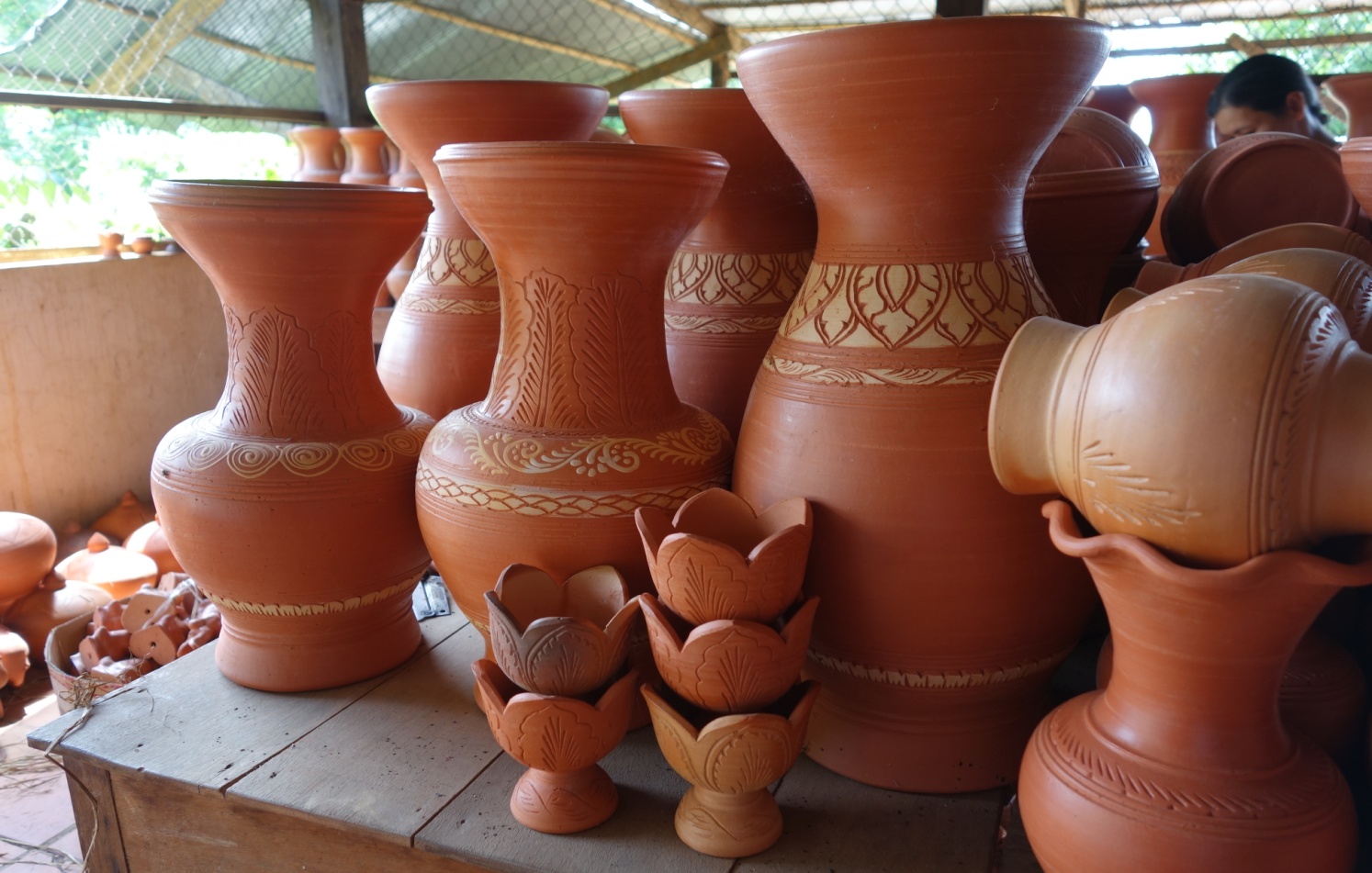
7.ANDONG RUSSEI POTTERY VILLAGE
- Distance: Located in 4 km west of Kampong
The village is around 4 kilometres from town, so it is easy to get access by bicycle. Moreover, the scenery on the way is simply fabulous. Guesthouses will provide directions instruction but the route is quite simple. With the provincial hall to your left and a small city park to your right, take the straight road that heads due west. This will lead you through classic Khmer landscapes of paddy dotted with sugar palms, with a range of low hills behind the village providing a good landmark. (It’s a straight line until you’re almost at the hills, whereupon a left turn at a T-junction takes you into the village.)
Most families here produce the pottery in their houses and any will be happy for you to take in, though the best organised for visits is a co-operative workshop at the entrance to the village on the right.
8.PHNOM NEANG KONG REI
- Distance: 14 km from province town
Phnom Neang Kang Rey as a natural reserve has been attracting large numbers of tourists from various areas of Cambodia as well as from other parts of the world. There are tall and beautiful trees and flowering plants that add to the natural beauty and charm of the place. You can go for a casual stroll and can organize natures walk along the wonderful Phnom Neang Kang Rey, Kampong Chhnang.
Phnom Neang Kong Rey is the most popular history attractive in Kampong Chhnang Province,Most of the tourist never missed to visiting Phnom Kong Rey due to they wanna know about the picture of Kong Rey Mountain.This Mountain was became form like a lady sleeping while there is a legacy story that has the highest point about 310 meters. Why this mountain was belong to Neng Kong Rey? This mountain came from a real movie In Khmer: Puthisen Neang Kong Rei
A short summary of Phnom Neang Kong Rey, Kong Rei is the name of a beautiful daughter of the ogress in the Khmer folk tale of the Twelve Sisters.The tale has been made into books, songs and movies. Suffice to say that the prince was forced to leave his beloved Neang Kong Rei to go on a mission, and used a spell to turn the intervening lands into water so she couldn’t follow him. Heartbroken, the princess cried herself to death at her loss and the mountain is said to resemble the shape of a prone, weeping maiden. Larger than life statues of the devastated girl and the departing prince on his trusty stead can be seen in the small traffic circle park close to the provincial hall.
ALL THINGS YOU SHOULD KNOW BEFORE TRAVELLING TO KAMPONG THOM
A visit to KampongThom on the Cambodia Adventure Tours is certain to appeal to those travellers that wish to avoid a lot of the hustle and bustle that is noticed in the main tourist sites throughout Cambodia, yet still wishes to explore spectacular locations, including the countryside.
Square: 13,814 km2 (5,334 sq mi)
Population: 708,398 (2009)
City: Stueng Saen
Districts: 8 districts: Baray, Kampong Svay, Stueng Saen, Prasat Ballangk, Prasat Sambour, Sandan, Santuk, Stoung
Neighbouring provinces: Siem Reap (northwest), Preah Vihear (north), Stung Treng (northeast), Kratie (east), Kampong Cham and Kampong Chhnang (south), and the Tonle Sap (west).
KAMPONG THOM HISTORY
Kampong Thom is Cambodia’s second largest province by area. Its capital is named Kampong Thom, a picturesque town on the banks of the Stung Saen River.The Sambor temple and Prei Kuk temple are the two main temples in Kompong Thom as well as other less significant Angkorian sites. Kompong Thom was a very powerful capital in Southeast Asia during the Funan period. Later on, during the French rule, the province was home to a large group named the Stieng, but they have long been assimilated into Khmer society.Kampong Pos Thom was the original name of the present called Kampong Thom. Because originally long time ago, at the dock of the Sen River next to a big natural lake, there was a big cave with a pair of big snakes inside. The people living around this area usually saw these big snakes every Buddhist Holiday. Time after that, the snakes disappeared, and the people of that area called it Kampong Pos Thom. Then, only short words Kampong Thom. During the French colony in Cambodia, the French ruled and divided Cambodian territory into provinces, and named them according to the spoken words of the people Kampong Thom Province.The provincial capital Kampong Thom is another bustling town on the banks of the Stung Sen River. The town itself is strategically located on the National Highway No 6 between Phnom Penh and Siem Reap. Its more a stopover to have a break from driving long distances or to eat something on the way to Siem Reap or Phnom Penh, than a very touristic place. Despite the town itself people come to explore the pre-Angkorian Chenla capital Sambor Prei Kuk, the remote temples of Preah Khan and Prasat Preah Vihear.

GEOGRAPHY
The province of Kampong Thom is about 15,061 km² in size. It is bordered by Siem Reap and Preah Vihear to the north, with Kratie to the east, with Kampong Cham to the south, and Kampong Chhnang to the west. It is split between 737 villages, 81 communes and 8 districts.
The province is split into two main parts that include about 70% of the surface area consisting of plateaus and forests which are very rich in natural resources to assist with forestry, agriculture and animal husbandry. The other 30% extends to the Tonle Sap Lake which is great for fishing and rice cultivation to fully support the needs of the local area.
KAMPONG THOM TRANSPORTATION
Getting in Kampong Thom There is no airport in Kampong Thom, you can get flight to Phnom Penh(160Km)/ Siem Reap (165km), then take about 2-2.5 hours driver along to National Highway 6 to get there. Buses/ Minivan are availble abd depart daily hour from Phom Penh/ Siem Reap, cost about $4-8/pax Getting around
The town is easily explored by foot. There are motorbike-taxis for hire to take you to more distant sights.
The town is not busy with tourists and tuk-tuk drivers can be very persistent – if you tell them where you are staying there is a good chance they will be waiting outside your accommodation when you wake up the next day.
ECONOMY IN KAMPONG THOM
Kampong Thom is also a province, rich in tourism potentials to attract national and international tourists such as the exotic lakes, rivers, forests, mountains and more than 200 ancient temples. Much of Kampong Thom is located on the floodplain of Lake Tonle Sap. In 2003-04 it was a significant harvester of wild fish (18,800 tons) and the fourth largest producer of fish through aquaculture in Cambodia (1,800 tons). Most fish-raising is home production, with a growing segment devoted to rice field aquaculture. Kampong Thom is also one of the largest producers of cashew nuts in Cambodia, with 6,371 hectares under production. The Riel is the local currency. However, the US Dollar is accepted (4,000 Riel to one U.S.D, July 05) and it is best to carry small denominations. Credit cards, Traveler’s Cheques and foreign currencies are accepted in major hotels, souvenir shops and banks. Newly installed Credit Card Teller distribution machines are now available in Siem Reap and Phnom Penh.
HOW TO GET KAMPONG THOM
Almost every bus running between Siem Reap and Phnom Penh stops in Kompong Thom, so your options for bus companies and times are virtually endless. GST and Sorya, companies with adjacent stations near Psar Thmei in Phnom Penh, have the most departure times, starting at 06:45 and departing all day and including night buses. Giant Ibis is the most luxurious. Kompong Thom is also the departure point for buses and minivans north to Preah Vihear.
For reasons best known to them, no travel agent will sell you a ticket to Kompong Thom from either Siem Reap or Phnom Penh so you will have to pay a full fare even if you get out half way. (Well, they will issue a ticket for Kompong Thom, but it’s the same price!) Prices range from $5.50 up to $12 or $15, depending on which company you use and how much commission the agent is charging. Smaller, 15-seater vans are somewhat faster and usually cost about $10 to $12. These can be bone-rattlers, especially if you’re coming from Phnom Penh.
Note that since all buses start in either Siem Reap or Phnom Penh (only shared taxis actually depart from Kompong Thom itself), many of these buses may be full when they reach half way. That doesn’t mean they won’t sell you a ticket anyway, but it means you may get another passenger on your lap or a seat on the floor. For this reason it’s risky to just flag a passing bus down and it is probably worth paying the commission to get a ticket.
GETTING AROUND
Most transport around Kompong Thom is by moto-dop or tuk tuk. A herd of drivers hangs out in front of Arunras and outside Kompong Thom market. Tuk Tuks will ask for $15 to Sambor Prei Kuk and $12 to Phnom Santuk (return trip, including waiting time).
THING TO SEE AND DO
Sambo Prei Kuh Temples
By adding the Sambo Prei Kuh Temples to your travel itinerary makes it possible to explore some of the finest temples in the local region. This area is quite large and includes over 100 temples constructed with solid brick, sandstone and laterite. This region has been used by several kings and maintained the site while also adding more monuments and temples throughout their rein.
Andet Temple
Built in the Prei Kmeng style, the Andet temple is constructed much like a single brick tower and located close to a modern Buddhist wat. It was built in the seventh century under the guidance of Jayavarman I.
Wat Kuhak Nokor
A visit to the 11th century site of the Wat Kuhak Nokor makes it possible to explore a series of sandstone and laterite structures that are still relatively well maintained and surrounded by an impressive 3 meter height rampart. This 200 m² park has many structures that are similar in style to the Tonlé Bati temple.
Home-stay in Baray District
For the traveller on the Cambodia tour packages that really want to experience the authentic rural life in Cambodia, a homestay in the Baray District is certain to appeal. This homestay tourism experience is based in a Khmer village that includes a community-based program that helps to capture the day-to-day life in the heartland of Cambodia. This type of travel experience includes plenty of activities beyond sustaining the ethnic houses including watching traditional dance performances, learning silk weaving, watch farmers tap Palm trees and ride on a bullock cart.
Stone handicraft
A visit to the Ka Kos Village in the Santhuk District which is approx. 16 km from Kampong Thom via national highway No 6 gives a great opportunity to watch the local craftsmen in action as they use local rocks to make various figures and statues for home decoration. These statues are created to sell to the international and domestic markets. Beyond the stone handicraft, there are plenty of other handicraft activities to see in the local area on the Cambodia travel packages such as traditional Khmer bags and clothing (silk shirts).
Bird Sanctuary of Boeng Tonle Chmar
The Bird Sanctuary of Boeng Tonle Chmar is a vast area that expands nearly 400 hectares which includes an interconnecting network of channels that lye along the Boeng Kla Lake that has plenty of flooded forests.
In addition to the local bird population, there are also many people living there on the river in floating houses who are required to move up and down the river according to the level of water in the flooded jungle forest.
SHOPPING
Kampong Thom has plenty of common markets that trade in the everyday goods like foods, garments, etc., as well as the more specialist handicrafts like statues, traditional Khmer clothing and bags, and silk shirts.
A great place to visit for stone handicraft is the Ka Kos Village in the Santhuk District which is approx. 16 km from the centre of town. By travelling on National Highway No 6 by tuk-tuk or taxi it is possible to reach the scene of statue making that includes a wide range of figures made in stone with the intended to sell to the international and domestic markets.
KAMPONG THOM TRAVEL TIPS
Stone Handicraft is located at Ka Kos Village, Ka Kos Commune, Santhuk District in 16-km distance from Provincial Town of Kampong Thom on National Highway No 6. The craftsmen take the rocks from the food of Santhuk Mountain to make statues and various figures for house decoration. This stone handicraft is served for domestically and internationally target markets. Beside stone handicraft, Kampong Thom has other handicrafts like Krama, Silk shirts, traditional Khmer clothing and handbags. There is also the common markets with all you may need (food, garments, etc.).
KAMPONG THOM CLIMATE & BEST TIME TO VISIT
The country has a tropical climate warm and humid. In the monsoon season, abundant rain allows for the cultivation of a wide variety of crops. This year-round tropical climate makes Cambodia ideal for developing tourism. Travellers need not to fear natural disasters such as erupting volcanoes or earthquakes, and the country is not directly affected by tropical storms. Climate: Cambodia can be visited throughout the year. However, those plans to travel extensively by road should be avoided the last two months of the rainy season when some countryside roads may be impassable. The average temperature is about 27 degrees Celsius; the minimum temperature is about 16 degrees. December and January are the coolest months, whereas the hottest is April.
General information about the provincial climate:
– Cool season: November- March (20-28c) – Hot season: March- May (30c -35c) – Rainy season: May – October (23-30c, with humidity up to 90%.) At this time of year it rarely rains in the morning: most precipitation come in the afternoon, and even then, only sporadically. Rainfall varies considerably from area to area, whereas the seaward slopes of the Southwest highlands (Kompong Som and Kampot provinces) receive more than 5,000 mm of rain per annum, the central lowlands average only about 1,400 mm.
KAMPONG THOM EAT & DRINKS
Most restaurant and dinning place in Kampong Thom is located in the town. And you can have a look at small night market stalls just in front of the market. By far the best khmer restaurant in Kompong Thom is located behind the Arunras Hotel on the corner of the market.
Food is excellent and this place is regularly visited by locals however there is no English language menu and the staff only speak Khmer. A number of large establishments on the road to Phnom Penh (marked by the ostentatious architecture) are frequented by upper-class Khmer but do good Khmer food.
Aruneas Guesthouse & Restaurant: The most popular restaurant in town with clean table, nice food and crowded, located beneath Arunras Guesthouse. They serve good Western, Chinese and Khmer food at cheap prices are popular. An English menu and staff that can speak the language are other nice features.
Neak Meas Hotel & Restaurant: This restaurant serve good Chinese and Khmer food in the morning and throughout the day until the nightclub kicks in around 8:30pm.
The American Restaurant: located at Por Chea Tepatey Road (on the side street down from the Arun Ras Hotel; across from the Department of Agriculture), 092 579 410. Serves handmade ice cream, Australian Beef burgers and homemade pizza. It is quite nice. The owners are friendly. The food is very good especially the ice cream and pizza and also offering Khmer menu. Also dishes normally taking a longer prep times such as sautéed fish with peanut herb sauce can be offered. Their fish Amok is nice testing.
Stung Sen Restaurant (near the river). The most up-market ‘tourist friendly’ restaurant in Kompong Thom. Mostlty attracts tour groups. Food not very good. edit
Monorom Restaurant: This restaurant, crowded by lots of locals is situated next to the Mittapheap Hotel. Its quite popular on the National Highway No 6 to the North and especially for its breakfast.
9 Makara Restaurant: Just north of the river bridge on the east side of Highway No 6 is a row of three restaurants, with the middle one being 9 Makara Restaurant and Nightclub. The restaurants are enclosed and serve Khmer and Chinese fare, with beer girls there to greet you in the evening.
Reaksmay Restaurant: One of the first restaurants you come across at Restaurant Row is this new and upscale place. It’s fairly fancy for Kampong Thom. They serve up a bit of Western food to go along with the Khmer and Chinese fare and it’s the home of the fancy-pants beer girl of Kampong Thom.
Super Soup Restaurant at the Stung Sen Royal Hotel. The Super Soup restaurant (try saying that quickly ten times) is everything that it’s billed to be a soup restaurant. Cheap Food Stands. There are simple rice and noodle dish stands in front of the market at the east side.
 Drinks
Beside Eating Khmer and Western Foods, you can try fresh Cambodian fruit shake at local price around 2000 Reil. They are mostly located and sell at night.