9 WONDERFUL DESTINATIONS YOU MUST CHECK IN PHNOM PENH
Phnom Penh is the vibrant bustling capital of Cambodia. Situated at the confluence of three rivers, the mighty Mekong, the Bassac and the great Tonle Sap, what was once considered the ‘Gem’ of Indochina. The capital city still maintains considerable charm with plenty to see. It exudes a sort of provincial charm and tranquillity with French colonial mansions and tree-lined boulevards amidst monumental Angkorian architecture. Phnom Penh is a veritable oasis compared to the modernity of other Asian capitals. A mixture of Asian exotica, the famous Cambodian hospitality awaits the visitors to the capital of the Kingdom of Cambodia.1.ROYAL PALACE
- Distance: 1.3 km from Phnom Penh
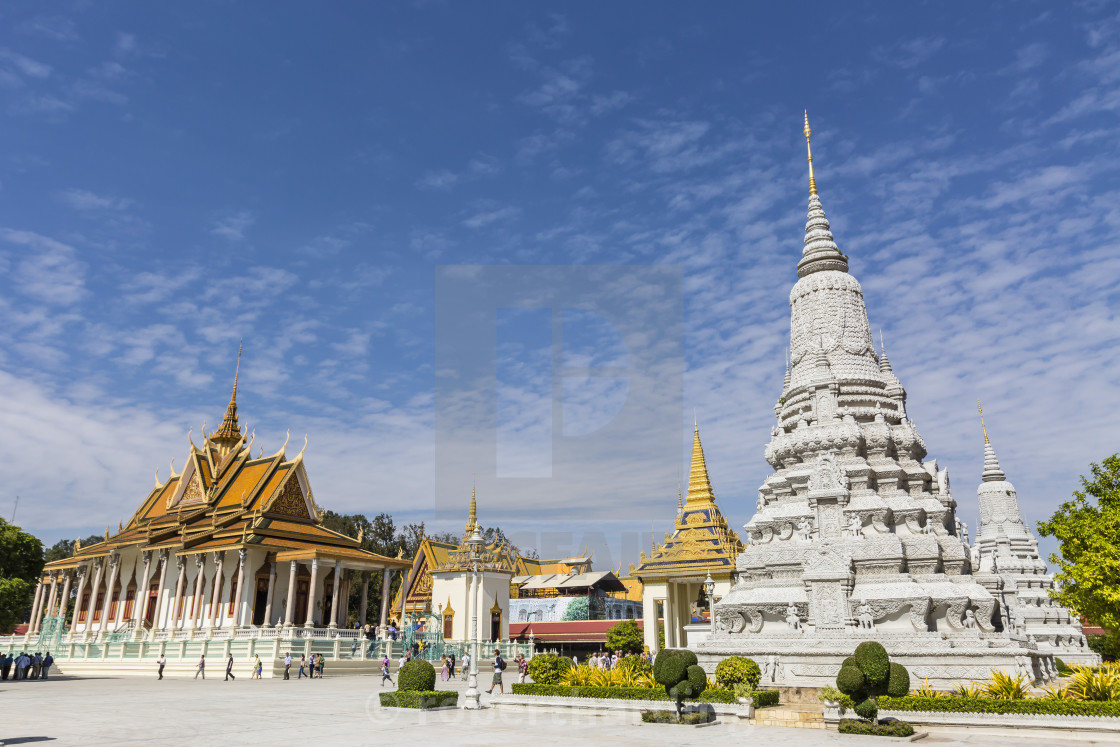
The Roy al Treasury and the Napoleon II villa lie south to the Royal Throne Hall. North to this stands the Silver pagoda enclosure, otherwise known as the Pagoda of the Emerald Buddha. The Pagoda?s steps are crafted from Italian marble, and within the throne room the regal floor consists of more than 500 solid silver blocks. If calculated together, they weigh nearly six tones. Displayed a round the room, surrounding the main area, stand plush presents from foreign dignitaries.
The magnificent 17th century emerald Buddha statue is made of Baccarat cuystal and solid gold. It weighs 90 kilograms and is adorned with 9,584 diamonds. Bronze statues stand to it?s left and right sides. Next to these, encased under a glass cover, reside a golden locus. Within this area other ancient treasures include a large Buddha?s footprint, representing the 108 past lives of the Buddha before he was re-incarnated as Prince Siddharta, who subsequently gained enlightenment. On the wall, surrounding the Pagoda compound, (the oldest par of the palace) are hundreds of meters of frescos depicting an episode of the Indian epic Ramayana. These are the biggest mural frescos in South East Asia.

2.SILVER PAGODA
- Distance: 1 km from Phnom Penh
Originally a wooden structure, the palace was initially constructed in 1892 during the reign of King Norodom, but rebuilt to its present grandeur by King Norodom Sihanouk in 1962. The king spared no effort to make this a true embodiment of brilliant Khmer art. More than 5300 pcs of 1.125 kilo silver tiles are used to cover the floor of the Silver Pagoda, and the silver pieces collectively weigh over six tons.
The staircase leading into the pagoda is marble, and inside, two breathtaking representations of the Buddha hold court. The Emerald Buddha is in fact made of Baccarat crystal, and dates back to the 17th century. A small glass case nearby enshrines a sacred Buddha relic brought from Sri Lanka in 1956 by the Venerable Loeva Em of Wat Lanka. However, the second statue of Buddha is the one that catches the eyes of visitors. Its 90 kilo gold body is studded with 2086 diamonds; the largest of which a 25 karats brilliant piece can be found on the Buddha’s crown. Cast in 1904 by King Sisowath at the request of his elder brother King Norodom, it represents Maitreya Buddha, the future Buddha.
There are a total of 1650 items on display at the temple. They include cast gold headdresses made especially for the royal dancers, many solid gold Buddha statues in different forms, gifts from royalties and dignitaries from around the world and a myriad of jewels and precious antiques.
3.NATIONAL MUSEUM
- Distance: 1,5 km from Phnom Penh
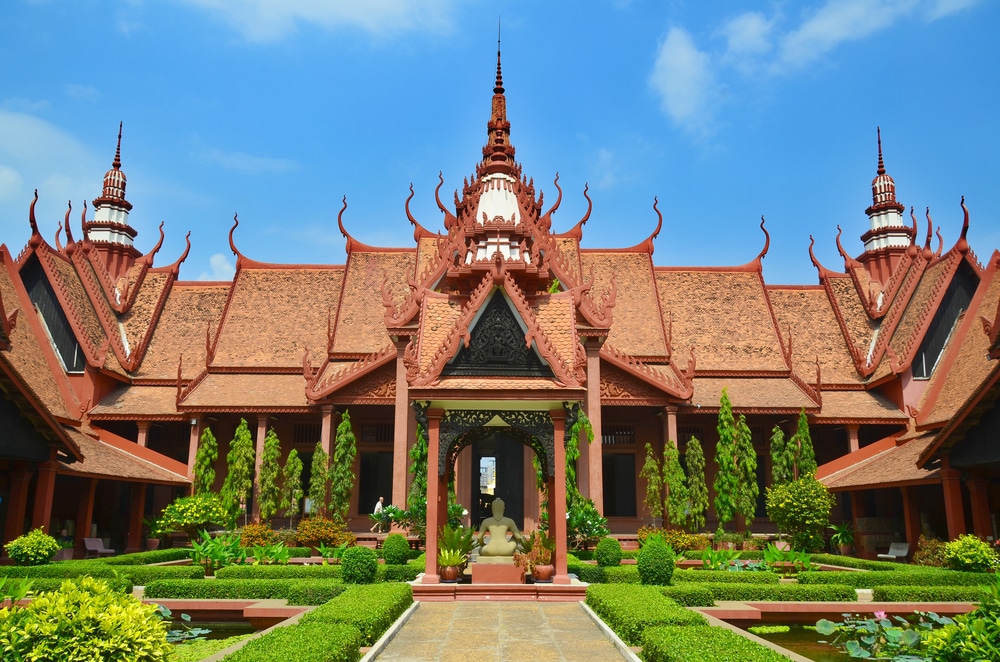
The museum promotes awareness, understanding and appreciation of Cambodia’s heritage through the presentation, conservation, safekeeping, interpretation and acquisition of Cambodian cultural material. It aims to educate and inspire its visitors.
Opening hours are from 8.00am until 5.00pm daily. Last admission tickets are sold at 4.30pm.
Admission costs are US$5 for foreigner ages from 10 to 17 years old, US$10 foreigner ages from 18 years old up , 500 Riels for Cambodians. Children and school groups are free.
Photography is not permitted within the museum galleries, but visitors are welcome to film or photograph the museum exterior and courtyard. Those wishing to obtain images of the museum or collection for study or Publications should email the museum to request an application form or contact a staff member.
Smoking is not permitted inside the museum.
The Museum store is located at the main entrance. Postcards, souvenirs, replica sculptures and books on a variety of art and culture topics are available.
Guides who speak French and English are available, and there is also a booklet – Khmer Art in Stone – available at the front desk, which gives a rundown with locations of the most important objects on display.
The museum comprises four courtyards which face onto a garden courtyards to the left and straight ahead of the entrance.

4.WAT PHNOM
- Distance: 3 km from Phnom Penh
As legend story told that in 1373, Mrs Penh (Yea Penh) picked up a driftwood on the river, inside had 4 Buddha statues so she decided to build a hill (Phnom means hill) and a small temple to put and worship those statues, for this reason the pagoda named Wat Phnom or many people call it as “Lady Penh” to remember the creator – Mrs Penh. At that time, Wat Phnom was very sacred and trusted by Cambodians, gradually the pagoda was famous and spread over the surrounding land also known as Phnom Penh were the hill meaning “Phnom” and paired with the name of the woman who built this hill – Mrs Penh. Hence some people said that the capital Phnom Penh was originally named like that story.
The pagoda was built in Khmer’s concept so that on the main entrance, visitors will see many statues of lions and Naga gods, the mythical snakes of Hinduism and Buddhism, which is why the Naga snacks are always present in every corner of many temples such as on entrances, on stairs or on the roofs of ancient temples to drive away evil spirits. Naga snacks are considered power gods to defend sacred places, be a symbol of prosperity and snacks are a specie capable of protecting water sources for Cambodians.
Be the most important pagoda in local people as well as popular destination, tourists should avoid the people selling birds in cages when visiting Wat Phnom. That’s a cheat because the birds are typically trained to return to their cages and then be sold by the others. To go to the pagoda, you can go by yourself or take a tuk tuk to pick you up. From Sisowath Quay street, walking about 5 minutes to the left, go to KFC store and turn left on Road 98 to a hill, where the sacred Wat Phnom is located. Opening hour is from 8:00 to 18:00 daily with the ticket fee is 1 USD.

5.CHOEUNG EK GENOCIDAL CENTER (KILLING FIELDS)
- Distance: 17 km South of Phnom Penh
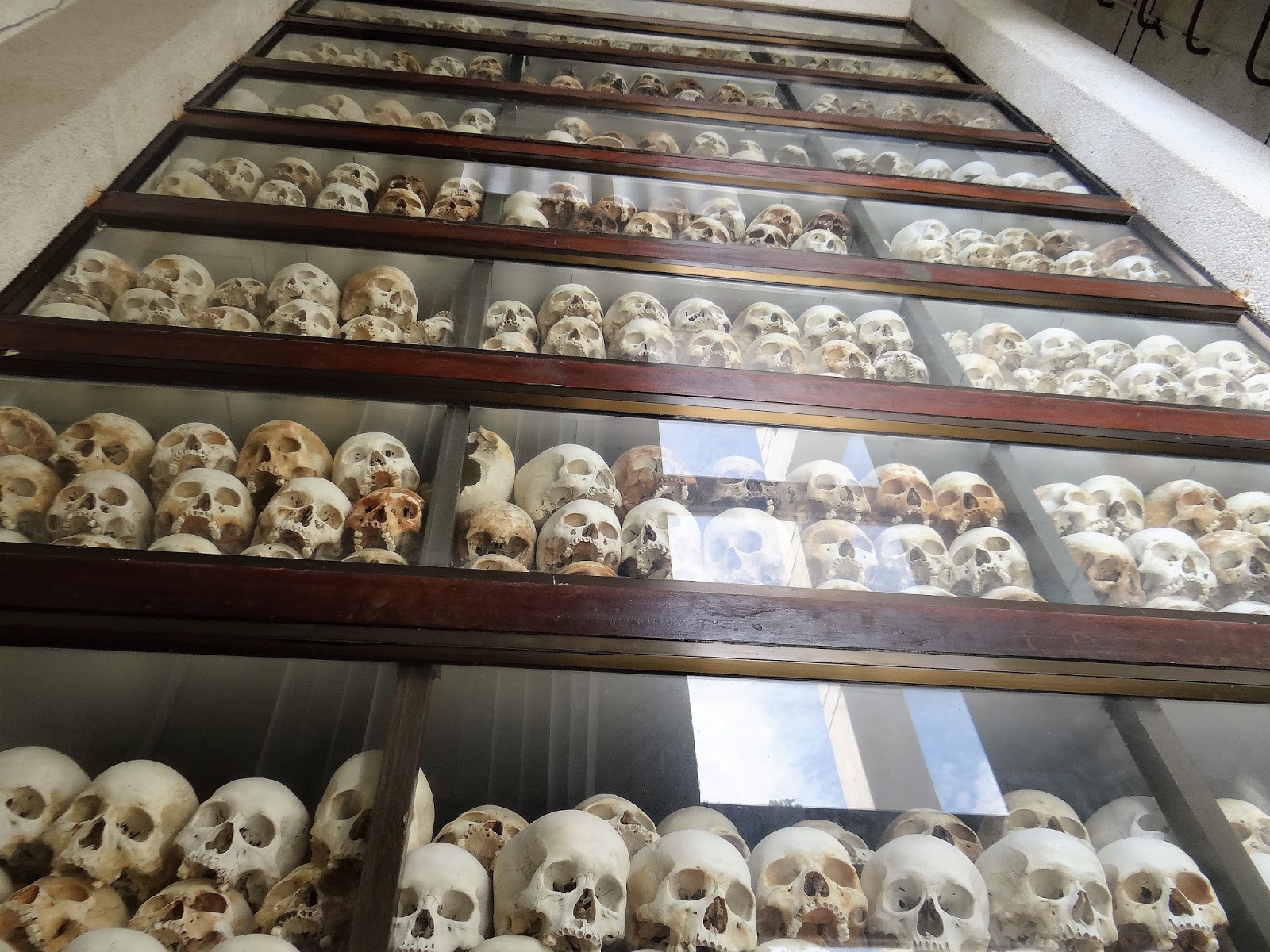
and today serves as a monument to all those who died – and survived. It also serves as an educational tool to ensure history never repeats itself.
6.TUOL SLENG MUSEUM (S-21)
- Distance: 1,8 km from Phnom Penh
7.INDEPENDENCE MONUMENT
- Distance: 1 km from Phnom Penh, 10 minutes walking behind the Royal Palace.
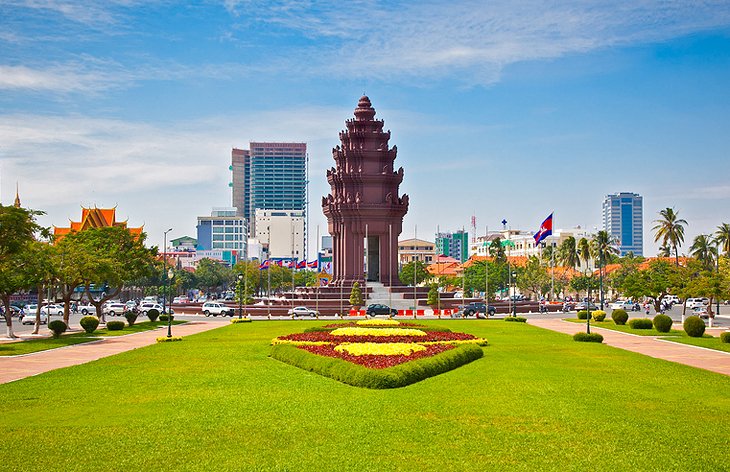
The Independence Monument (Vimean Ekareach) was inaugurated on November 9, 1962 to celebrate the independence from the French in 1953, but now also serving as a cenotaph to Cambodia?s war dead. The 20-meter high monument was designed by Cambodian architect, Vann Molyvann, and is shaped in the form of a lotus, which also can be seen at Angkor and other Khmer historical sites. You are not allowed to enter the monument. At night it is lit with blue, red and white light (the colours of the national flag) and it should be an impressive sight
The monument was built in 1962 to celebrate Cambodia’s independence from the foreign rule. It also serves as a monument to Cambodias war dead. It is the site for celebrations and services.When walking around in the city of Phnom Penh, have a look on the Independence Monument,10 minutes walking behind the Royal Palace.
It stands on the intersection of Norodom and Sihanouk Boulevards in the centre of the city. It is in the form of a lotus-shaped stupa, of the style seen at the great Khmer temple at Angkor Wat and other Khmer historical sites.The Independence Monument was inaugurated in 1958 to celebrate Cambodia’s independence from foreign rule, now it also serves as a monument to Cambodia’s war dead. At night the monument is illuminated by red, blue and white floodlights, the colors of the Cambodian flag. It is the site of celebrations and services on holidays such as Independence Day and Constitution Day.
8.PHNOM PENH NIGHT MARKET
- Distance: 2 kms from Phnom Penh
It opens from 17.00 to 00.00, from Friday to Sunday. This time gathers the largest quantity, modals of goods and products so that you can see and enjoy more interesting things here.
This market is just over 2 km from the city center, it takes you a few minutes to go there by tuk-tuk, taxi or bicycle. Or when your cruise stops here, you can walk through this interesting market.
9.RUSSIAN MARKET
- Distance: 3,3 kms from Phnom Penh
Located at the south end of the French’s Quarter, the market now is a must-do for first-time visitors: it’s busy and full of life, as well as being about to present thousands of stuff you don’t really need or buy but you’ll quite enjoy spending time watching them there. Raging from Hardware goods, drinks and food, antique furniture, hand-woven silk, traditional carvings to even DVDs and jewelry, the market is overwhelming yet interesting to do a deep exploration. Since navigating it can be tricky, our guide will help you walk through it. Give yourself at least an hour for each aisle and stall will have something different.
It opens from 7:00 am up to 11:00 pm (for souvenirs shop). So if you are tired of temple-hopping, come here to get closer to the lifestyle of the local people. Inquire a tour to this unique market in Phnom Penh!
ALL THINGS YOU SHOULD KNOW BEFORE TRAVELLING TO PHNOM PENH
Despite being known at various times in its history as “The Pearl of Asia” and “City of Four Faces” (situated where the Mekong, Tonle Sap and Bassac rivers collide), Phnom Penh receives only a fraction of visitors that its neighbors get, sometimes entirely bypassed on the Bangkok – Siem Reap – Ho Chi Minh tourist trail.PHNOM PENH HISTORY
The city takes its name from the re-known Wat Phnom Daun Penh (nowadays: Wat Phnom or Hill Temple), which was built in 1373 to house five statues of Buddha on a man made hill 27 meters high. These five statues were floating down the Mekong in a Koki tree and an old wealthy widow named Daun Penh (Grandma Penh) saved them and set them up on this very hill for worshiping. Phnom Penh was also previously known as Krong Chaktomuk (Chaturmukha) meaning “City of Four Faces”. This name refers to the confluence where the Mekong, Bassac, and Tonle Sap rivers cross to form an “X” where the capital is situated.
HOW TO GET TO AND FROM PHNOM PENH
By Air
Phnom Penh’s international airport, going by the name Pochentong and the code PNH, lies around 10 kilometres west of the city centre.
Domestic destinations are limited to Sihanoukville and Siem Reap though there are direct flights to most major regional airports including Ho Chi Minh, Hanoi, Vientiane, Bangkok, Kuala Lumpur, Singapore and Yangon. Chinese destinations are well represented and there are also regular flights to Tokyo, Taipei, Seoul and even Hyderabad although, due we assume to runway dimensions, there aren’t at present any longer-haul flights on offer.
With the National Highway 6 to Siem Reap much improved a minibus can do the road trip in not much more than 5 hours so, if you factor in travel to the airport, check-in time, flight, baggage collection and taxi into Siem Reap, you’d be saving around 1 hour 30 minutes assuming there are no delays. Furthermore, your taxi to Pochentong alone is going to be more expensive than a bus ticket all the way to Siem Reap. Ditto Sihanoukville so, suffice to say, we reckon domestic flights in Cambodia are, to say the least, an extravagance.
By Trains
Next negative point is that while official blurb claims “less than 30 minutes” in reality it can be much slower and you can wait a long time for a train. (We heard of someone taking three hours from arrival at the station to arrival at Pochentong.) Lastly, aside from perhaps the Phnom Penh Hotel, there is very little accommodation near the station so it’s not a useful part of town to arrive in.
With city traffic only looking to worsen in the immediate future and a sensible, automated, flight check-in facility set up at the station, we’d put this new feature down as having potential but not as yet a really viable option.
By boat
Boats are medium-sized craft with air-con interiors and some coming with a rear deck seating area. Journey time is around 5 to 6 hours including border processing. Boats travel down the main channel of the Mekong until, after the border they take a canal linking up to Chau Doc on the banks of the Bassac River. Scenery isn’t spectacular but it certainly makes a pleasant change from the bus.
The passenger port along with boat company desks is located on Sisowath Quay, next to the ominously named Titanic Restaurant and opposite the Night Market. Tickets are also available, usually for small commissions, from travel agents and hotel and guesthouse receptions as well as online sites.
Other
Inter-province taxis and shared taxis
If there are two or three of you travelling together then for longer journeys from the capital a good compromise solution—between standard buses and flights—could be to hire a private taxi. These offer the advantage of picking up and dropping-off at whichever points you desire, at whatever time you prefer and with stops on the way (within reason) of your own choosing. (We say within reason as drivers will demand a supplement if they consider you’re requesting too many, or too lengthy stops.)
Taxis are relatively good value for money in Cambodia and if you don’t overload the vehicle and you have a decent driver then it’s also a comfortable way to travel.
PHNOM PENH TRANSPORTATION
Phnom Penh is a sprawling city and very hot. There are very few crosswalks, and sidewalks are used for parking. All said, Phnom Penh is not a pedestrian-friendly city. Most locals, expats, and tourists choose to get around by bicycle, moto, tuk tuk, or taxi.
Tuk tuks are generally the most pleasant way to travel. Whether you’re going to be in Phnom Penh for a week or for a year, it makes sense to get to know a few tuk tuk drivers. Using the same driver regularly means lower prices, less hassle, and much less time spent explaining where it is you are trying to go. It’s also easier to have a regular in your neighborhood (or outside your hotel) so you don’t need to call and wait for a driver every time you want to go somewhere.
You can rent motos by the day, week, or month from Lucky Lucky! Motorcycle Shop, Phnom Penh’s most popular (with expats, anyway) moto rental and travel agency. The cost is $4 per day or $5 for an automatic, $25 for a week or $30 for an automatic, or $60 for a month or $70 for an automatic. You will need to leave your passport as collateral.
Taxis are just starting to become popular in the Charming City and, surprisingly, they are often cheaper than tuk tuks. There aren’t any taxi stands in Phnom Penh yet, so you’re best off calling and ordering a taxi to your location. Most of the taxi companies operate 24 hours a day, but they are not necessarily centrally located, so it’s best to call in advance.
Phnom Penh finally has a (small) bus network. Tickets are inexpensive, they are air-conditioned, and this can be an easy way to get to the airport.
ARTS, CULTURE AND ENTERTAINMENT IN PHNOM PENH
The Khmer Rouge banned Cambodia’s traditional arts and culture, but since then it has seen a revival. The Chaktomuk Theatre in Phnom Penh hosts several musical performances, and Sovanna Phum (meaning Golden Era) is an independent Khmer association focussed on the performing arts in Cambodia.
Performances include folk and classical dance, mask theatre, music, circus performances and shadow puppetry. There are performances at the theatre every Friday and Saturday night.
The theatres of Phnom Penh also play host to the Cambodian International Film Festival. The Meta House promotes the development of contemporary Cambodian art.
Phnom Penh also has a volunteer cinema called the flicks which has comfy sofas and popcorn and shows a variety of Western and Cambodian films.
SHOPPING IN PHNOM PENH
Phnom Penh has several lively and colourful markets to visit. Here you can shop for clothes and souvenirs to your heart’s content, but you may not have time to visit all of the markets. Try the Russian market, which is at the southern end of town; it has an array of jewellery, gems, ethical crafts, food, Khmer souvenirs and more. The markets are liveliest in the morning, and things wind down by 5 pm. From 5 pm you can visit the night market down by the riverside. It has a mixture of clothes and food. There are also several shopping malls around the city.
Try Tree-lined St 240 for boutique shops, mainly selling clothes and homewares, and almost all with an ethical slant. They are open daily from 8 am–8 pm. Numerous NGOs and other organisations have shops and outlets that directly help street children, women at risk, the disabled and other disadvantaged groups. The Daughters of Cambodia in Sisowath Quay is one such boutique selling interesting jewellery and accessories. The shop is run by women who have been rescued from the sex trafficking industry and the profits go toward saving other victims. You can sponsor a girl and donate directly to the foundation.
SAFETY IN PHNOM PENH
It’s best to be extra vigilant when travelling at night. There are instances of robberies and bags being snatched from tourists walking around key tourist areas, including the riverfront and Central Market. Moto riders have also fallen prey to bag snatchers. Keep your bag well out of sight and consider wearing a money belt to stay safe. Phnom Penh is safe to travel in, but gun crime is a regular occurrence. Crime usually reaches a peak at festival times and Khmer New Year.
10 BEST THINGS TO DO IN PHNOM PENH
- See the monks in the morning. Saffron robes and bare feet are a common sight in Phnom Penh. Starting at around 6am each morning, the city’s monks begin to emerge from their wats to collect morning alms and food offerings, stopping at shop doorways to chant blessings as they make their daily procession through the streets.
- Go on a self-guided walking tour of central Phnom Penh.
- Get lost in a local market. Whether you’re scouting for something specific or just window shopping, Phnom Penh’s wet and dry markets (called phsar in Khmer) are a must-visit. Try Tuol Tom Poung (the Russian Market), Central Market, Olympic Market and the Night Market for starters, and be sure to venture to some of the city’s lesser-known markets for a more local experience.
- Tour Kingdom Breweries. Beer is big business Cambodia, and Kingdom Breweries offers some of the country’s finest ales. Unscheduled guided tours of the biggest craft brewery in Southeast Asia (which is located on the riverside just north of the city) leave from the onsite Taproom bar between 1pm and 5pm, Monday to Saturday.
- See the sun go down.
- Go for a bike ride through Phnom Penh’s green space. When I lived in Phnom Penh, my favourite weekend activity was jumping on my bike and cycling the Mekong Islands. There are a string of lush islands set in the river and accessible by car ferry from the city.
- Stroll along Sisowath Quay at dusk. A Mekong River cruise is a popular choice for travellers wanting to see Phnom Penh’s riverfront at dusk, but in the dry season the water is low, making it difficult to see anything over the high river banks.
- See sericulture and silk weaving on Koh Dach. A narrow island in the middle of the Mekong, Koh Dach (or ‘Silk Island’, sometimes called ‘Mekong Island’) can be easily reached by tuk-tuk, moto or bicycle from Phnom Penh.
- Walk yourself down Street 13. Not all of Phnom Penh’s streets warrant a walking tour, but Street 13 which links the National Museum and Chinese House is a popular route if you want to take in colonial architecture and bustling markets in equal measure.
- Immerse yourself in urban art culture. Phnom Penh has some awesome murals by local and international street artists. Some of the best pieces can be seen around Street 240.
THE WEATHER & BEST TIME TO VISIT PHNOM PENH
As general weather in Cambodia, the best time to visit Phnom Penh is from November to April – during dry season.NORTHEASTERN (Siem Reap, Phnom Penh, Battambang)
Rain season (Apr – Oct): The temperature is around 30°C, followed by high humidity and strong wind. The rainfalls are usually in short downpour and infrequent form.
Dry season (Nov – Mar): The Northeastern monsoon brings dry wind, long sunny days to the areas. The temperature fluctuates (20 – 35°C) between cool months (Nov – Jan) and scorching month (Apr).
The best time to visit really depends on your style of travel.
If you wish to travel when the weather is at its best, then we recommend you organize your trip for November to March. Be aware though that you will be scrambling for space in the hordes of tourists as you will be travelling through Cambodia during their high season.
If you want to see Cambodia all green and lush, then we recommend you book a trip in their shoulder season, which is from July to August. You should know though, that you will also most likely have some rainy days on the trip during these months.
Lastly, if you wish to explore the temples and other attractions without the crowds squashing you, then we recommend a trip between April to June or September till October. You will need to cope with the weather though! April and May are their hottest months and it gets HOT, whilst September and October are their wettest months.
FOOT & DRINKS
As you stroll around Phnom Penh busy markets and bustling streets, you will pass hundreds of food stalls selling delicious morsels, ranging from pat on fresh bread to barbecued shrimps. It seems as if the charcoal powered woks, grills, and ovens never have a chance to cool down.Phnom Penh food culture is a product of the long and rich history and influence from its neighboring countries. The Khmer period, from approximately 800 to 1400, is considered one of the most defining in Cambodian history in terms of art and culinary development. This is why many traditional Cambodian dishes are referred to as Khmer style.
Apart from Khmer and street food, Phnom Penh is quickly becoming a modern city with a wide range of international cuisine. However, Phnom Penh has long been influenced by China, Thailand, and Vietnam in terms of cuisine, and it is easy to find Cambodian versions of the Vietnamese Banh Mi and cold Thai Salads.
 Drinks
Fruit juice and iced coffee are the two main favorite drinks in Phnom Penh. Are you saying, coffee? Yes! Cambodia used to be a French Indochina Colony and has, ever since, been in love with coffee. Below are a few of the best places to stop for a drink.